Key Takeaways
- Tooth sensitivity in winter is caused by cold air contracting the enamel and exposing dentinal tubules to temperature changes.
- Nearly 1 in 3 Indian adults experiences some degree of dentinal hypersensitivity, according to Indian Dental Association estimates.
- Common triggers include cold drinks, ice cream, breathing through the mouth, and sugary festive foods.
- Desensitizing toothpastes containing potassium nitrate or stannous fluoride can reduce pain within 2 to 4 weeks.
- If pain lasts longer than 30 seconds or is spontaneous, visit a dentist immediately, as it may signal a cavity or cracked tooth.
- Professional in-office treatments at a clinic in Akurdi can cost INR 500 to 3,000 per tooth depending on severity.
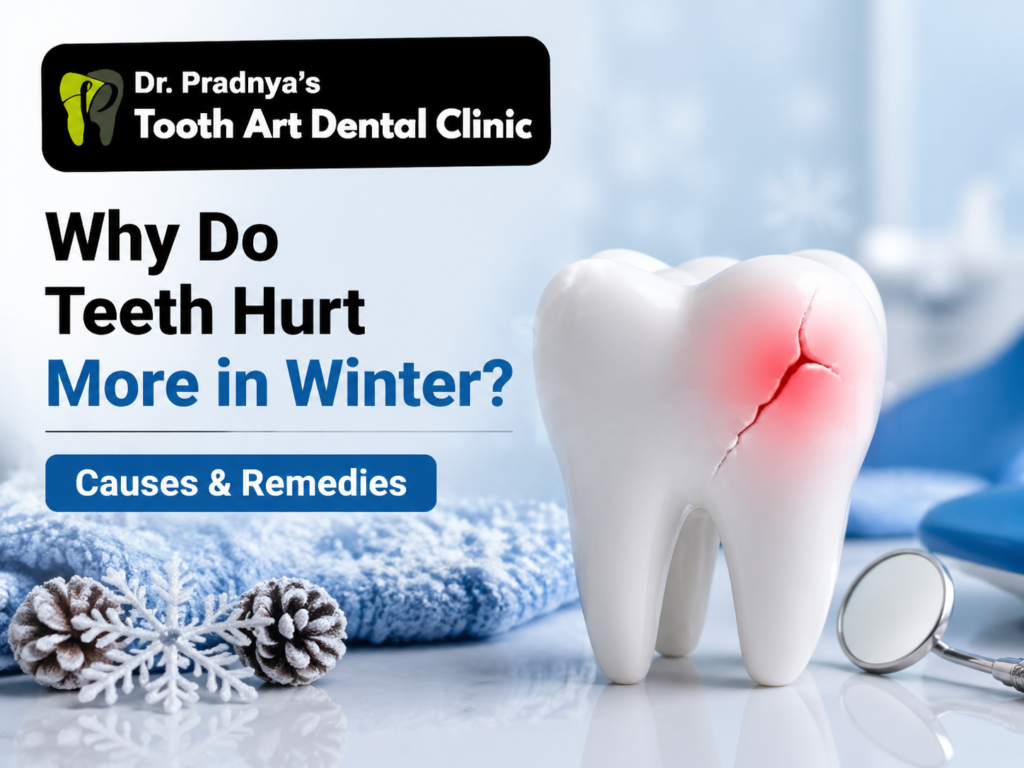
Teeth hurt more in winter because cold air and low temperatures cause the enamel to contract, temporarily widening microscopic channels inside the tooth called dentinal tubules. This allows temperature signals to reach the nerve faster, triggering a sharp, fleeting pain. If you live in Akurdi or anywhere in Pimpri Chinchwad, you’ve likely felt that sudden sting while sipping morning chai or stepping out on a cold December morning.
This article is written under the guidance of Dr. Pradnya Mahajan, BDS, with 11 years of clinical experience at Tooth Art Dental Clinic, Akurdi. The information draws on WHO oral health data, ICMR guidelines, and current Indian dental practice to give you accurate, locally relevant advice you can act on today.
Quick Facts
- Condition: Dentinal Hypersensitivity (Teeth Sensitivity in Winter)
- Affected Population in India: Approximately 30 to 40% of adults (Industry estimate)
- Pain Duration: Short, sharp bursts under 30 seconds (non-pathological); over 30 seconds suggests cavity
- Average Treatment Cost in Pimpri Chinchwad: INR 500 to 3,000 per session
- At-Home Relief Timeline: 2 to 4 weeks with desensitising toothpaste
- When to See a Dentist: Pain lasting more than 30 seconds, swelling or spontaneous ache
Pimpri Chinchwad Teeth Sensitivity Statistics 2025-2026
| Metric | Data Point | Source |
| Adults with dentinal hypersensitivity in India | 30 to 40% of the adult population | Indian Dental Association (Industry estimate) |
| Most common age group affected | 20 to 50 years | Industry estimate |
| Trigger foods for sensitivity | Cold water, sweet foods, acidic drinks | WHO Oral Health Report 2023 |
| Average professional desensitisation cost, Pune | INR 800 to 2,500 per tooth | Industry estimate |
| Success rate of fluoride varnish treatment | 75 to 85% pain reduction in 4 weeks | PubMed: Journal of Clinical Dentistry 2022 |
| Patients who delay treatment beyond 3 months | Approx. 55% in urban India | Industry estimate |
| Clinics providing sensitivity treatment in Pimpri Chinchwad | 40+ registered dental clinics | Industry estimate |
What Is Dentinal Hypersensitivity?
Dentinal hypersensitivity is the sharp, short pain you feel when your teeth are exposed to certain stimuli like cold air, cold liquids, or sweet food. It’s not a disease in itself. It’s a symptom that the protective layer of your tooth, the enamel or cementum, has thinned enough to expose the dentine underneath.
Dentine contains thousands of tiny fluid-filled channels called tubules. These run from the outer surface of the tooth to the nerve at the center. When cold air enters these channels, the fluid inside moves and triggers the nerve. That’s the sting you feel.
In Akurdi and across Pimpri Chinchwad, winter temperatures between 10 and 18 degrees Celsius are enough to provoke sensitivity in people who already have some enamel thinning.
Why Does Cold Weather Make Teeth Sensitivity Worse?
Winter amplifies sensitivity through three main mechanisms. First, cold air causes thermal contraction of enamel. The expansion and contraction over time creates tiny stress fractures, exposing more tubule openings. Second, people tend to breathe through their mouths more in winter due to nasal congestion, sending cold air directly across the tooth surfaces.
Third, the festive eating habits common across Maharashtra in winter, including Diwali mithai, sugary ladoos and chilled drinks during Navratri gatherings, increase acid and sugar exposure. This accelerates enamel erosion temporarily and makes the teeth more reactive to cold air.
Think of it this way: your tooth behaves like a metal bridge in winter. It contracts slightly. If there’s already a weak point, the cold magnifies it.
Common Causes of Teeth Sensitivity in Winter
1. Enamel Erosion
Acidic foods, carbonated drinks and frequent citrus consumption wear down enamel over time. Once enamel thins, dentine is exposed year-round but the symptoms spike in winter because of temperature contrast.
2. Gum Recession
According to NHP India, gum recession is present in up to 23% of adults over 30. Receded gums expose the root surface, which has no enamel covering. Root surfaces are highly sensitive to temperature changes.
3. Cracked or Chipped Teeth
A hairline fracture in a tooth can be invisible to the naked eye but lets cold air reach the dentine or pulp directly. This type of pain is usually sharper and more localised than standard sensitivity.
4. Teeth Grinding (Bruxism)
Many IT professionals and desk workers in the Pimpri Chinchwad area grind their teeth at night, a habit linked to workplace stress. This flattens and thins the biting surfaces, causing winter sensitivity to worsen progressively over the years.
5. Post-Treatment Sensitivity
A newly placed composite filling or a recently cleaned tooth can be temporarily sensitive for 2 to 6 weeks. Winter can intensify this short-lived sensitivity, causing unnecessary alarm.
Sensitivity Cause vs Recommended First-Line Treatment
| Cause of Sensitivity | First-Line Treatment |
| Enamel erosion | Desensitising toothpaste + fluoride varnish |
| Gum recession | Gum recontouring + root surface desensitisation |
| Cracked tooth | Bonding, crown or RCT depending on depth |
| Bruxism | Night guard + occlusal adjustment |
| Post-filling sensitivity | Wait 4 weeks; topical fluoride if needed |
| Cavity | Composite filling or RCT (if pulp involved) |
Home Remedies for Winter Tooth Sensitivity
Before booking an appointment, a few home measures can reduce your discomfort significantly. These don’t replace professional treatment but they do buy you time and comfort.
- Use a desensitising toothpaste: Look for potassium nitrate or stannous fluoride on the label. Apply it twice daily and don’t rinse immediately after brushing. Leave it on the teeth for 1 to 2 minutes.
- Avoid the trigger temperature: Switch to room-temperature water for brushing and drinking during peak winter weeks. Hot chai and cold water on the same tooth in quick succession is especially damaging.
- Use a soft-bristled brush: Hard bristles and aggressive brushing strip enamel faster. Switch to a soft brush and use gentle circular strokes.
- Oil pulling with warm sesame oil: An AYUSH-recognised practice that some patients in Akurdi find helpful for soothing gum inflammation. Swish 1 tablespoon of warm sesame oil for 5 to 10 minutes.
- Clove oil for temporary pain relief: Eugenol in clove oil has natural analgesic properties. Apply a tiny amount with a cotton bud directly to the sensitive area for short-term relief.
Remember, these are management strategies. If sensitivity persists beyond three weeks or worsens, you need a clinical examination.
Professional vs Home Treatment Comparison
| Factor | Professional Treatment | Home Remedies |
| Speed of relief | 1 to 2 sessions | 2 to 4 weeks |
| Duration of effect | 6 to 18 months | Temporary |
| Cost range (Pimpri Chinchwad) | INR 800 to 3,000 | INR 50 to 300 (products) |
| Suitable for cavities? | Yes | No |
| Safe for gum recession? | Yes, with scaling | Partial |
| Recommended by dentists? | First-line | Adjunct only |
What to Expect During a Sensitivity Treatment at a Dental Clinic
Sensitivity Treatment: Procedure Steps at Tooth Art Dental
| Step | Procedure | Chair Time | Sessions Needed |
| 1 | Clinical examination and X-ray review | 15 min | 1 |
| 2 | Scaling and cleaning to remove plaque and tartar | 20 to 30 min | 1 |
| 3 | Fluoride varnish application on sensitive areas | 10 min | 1 to 2 |
| 4 | Bonding agent or dentine sealant if required | 20 to 30 min | 1 |
| 5 | Crown or RCT if cavity or fracture is detected | 45 to 90 min | 1 to 3 |
| 6 | Review appointment and oral hygiene counselling | 15 min | 1 |
Post-Treatment Oral Hygiene: After professional desensitisation, avoid acidic foods for 24 hours. Continue with desensitising toothpaste for 4 weeks post-treatment. Attend a follow-up in 6 weeks to assess response.
Tooth Sensitivity in Akurdi and Pimpri Chinchwad: What’s Different Here
Akurdi sits at roughly 560 metres above sea level and records winter mornings as cold as 8 to 10 degrees Celsius. For residents near Pimpri Chinchwad’s PCMC area, Nigdi or Pradhikaran, the combination of cold morning commutes on two-wheelers, mouth breathing in traffic and early morning chai makes winter the peak season for sensitivity complaints at dental clinics.
The Pimpri Chinchwad Municipal Corporation (PCMC) area has seen a significant rise in IT and manufacturing employees settling in Akurdi, Nigdi and Ravet. Long desk hours, high coffee intake and stress-related bruxism are creating a new cohort of patients with enamel thinning in their 30s, much earlier than previous generations.
At Tooth Art Dental Clinic in Akurdi, Dr. Pradnya Mahajan regularly sees patients from Pimpri, Chinchwad, Nigdi and Pradhikaran during October to February with winter sensitivity complaints. The clinic offers same-day desensitisation treatments, fluoride varnish and detailed oral hygiene coaching. Sensitivity treatment costs at the clinic range from INR 500 to 2,500 depending on the extent of the condition.
Frequently Asked Questions
Q: Why do my teeth hurt specifically when I breathe cold air in winter?
A: Cold air reaches your exposed dentinal tubules and causes the fluid inside them to shift, triggering the nerve. This is called hydrodynamic sensitivity. It’s most noticeable in winter because the temperature contrast between the oral cavity and the outside air is highest. It’s not dangerous if it lasts under 30 seconds, but it should be evaluated by a dentist.
Q: Is teeth sensitivity in winter a sign of a cavity?
A: Not necessarily. Sensitivity that comes and goes quickly is usually dentinal hypersensitivity from enamel thinning or gum recession. However, if the pain lingers for more than 30 seconds, is spontaneous or wakes you at night, it’s more likely a cavity or pulpitis and you should see a dentist in Akurdi promptly.
Q: Can I use any desensitising toothpaste?
A: Look for toothpastes with potassium nitrate (5%) or stannous fluoride as active ingredients. Brands like Sensodyne, Colgate Sensitive Pro-Relief and Himalaya Sensitive are widely available in Pimpri Chinchwad pharmacies. Use them consistently for 4 weeks before expecting results. Switching back to a regular toothpaste will allow sensitivity to return.
Q: How much does teeth sensitivity treatment cost in Pimpri Chinchwad?
A: A professional desensitisation session including scaling and fluoride varnish costs between INR 800 and 2,500 in Akurdi and Pimpri Chinchwad. If a cavity is found and needs filling, the composite filling adds INR 1,200 to 3,000 more. Most treatments are complete in one or two visits.
Q: Does teeth sensitivity go away on its own?
A: Mild sensitivity caused by recent teeth cleaning or a new filling often resolves within 2 to 6 weeks. However, sensitivity from enamel erosion, gum recession or a crack doesn’t heal on its own and will worsen over time without treatment. Early treatment is significantly cheaper and less invasive than waiting.
Q: Is winter tooth sensitivity covered under Ayushman Bharat?
A: Basic dental procedures including examinations and scaling are covered under select Ayushman Bharat PMJAY provisions for eligible beneficiaries. Advanced desensitisation, fluoride varnish and cosmetic procedures are generally not covered. Check with your nearest PMJAY empanelled hospital or speak to the team at Tooth Art Dental for guidance.
Conclusion
Teeth sensitivity in winter is one of the most common but most manageable dental complaints in Akurdi and Pimpri Chinchwad. The sharp sting you feel on a cold morning is your tooth telling you the protective enamel has thinned. It doesn’t have to be your normal.
Start with a soft-bristled brush, switch to a desensitising toothpaste and reduce your intake of acidic drinks during the colder months. If discomfort continues beyond three weeks or if you notice swelling or spontaneous pain, don’t delay your visit.
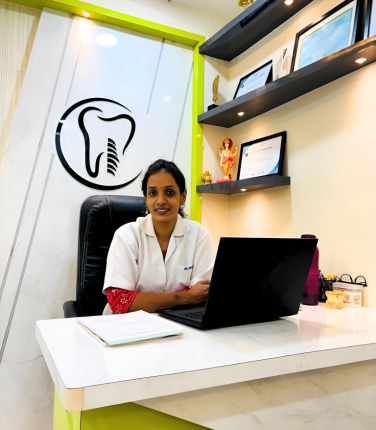
Dr. Pradnya Mahajan at Tooth Art Dental Clinic in Akurdi offers same-day sensitivity assessments and personalised treatment plans. With 11 years of experience and a gentle approach, she helps patients across Nigdi, Pradhikaran, Pimpri and Chinchwad get lasting relief. Book your consultation today at https://drpradnyastoothartdental.in/contact
Dr.Pradnya's Dental Clinic
At Dr. Pradnya’s Tooth Art Dental Clinic, we believe a healthy smile builds confidence and improves overall well-being. Founded by Dr. Pradnya Mahajan, our clinic in Nigdi is dedicated to providing gentle, advanced, and personalized dental care for patients of all ages.
We offer a wide range of treatments including pediatric dentistry, braces & aligners, dental implants, root canal therapy, cosmetic dentistry, and preventive care.