Key Takeaways
- Cold air triggers tooth sensitivity in susceptible teeth by rapidly changing the temperature of the dentine fluid within the tiny tubules that run through the tooth.
- Teeth with exposed dentine from enamel erosion, gum recession, recent scaling or cracked enamel are most sensitive to winter cold in Pimpri Chinchwad.
- Sensitivity toothpaste with potassium nitrate or stannous fluoride significantly reduces cold sensitivity within 2 to 4 weeks of consistent twice-daily use.
- Cold weather in Pimpri Chinchwad (December to February) also causes dry mouth in patients who breathe through their mouth, increasing cavity risk.
- A fluoride varnish application at Tooth Art Dental in Akurdi provides immediate surface protection for multiple sensitive teeth in a single appointment.
- Persistent cold sensitivity in one specific tooth (rather than generalised sensitivity) may indicate a cracked tooth or a failing restoration requiring evaluation.
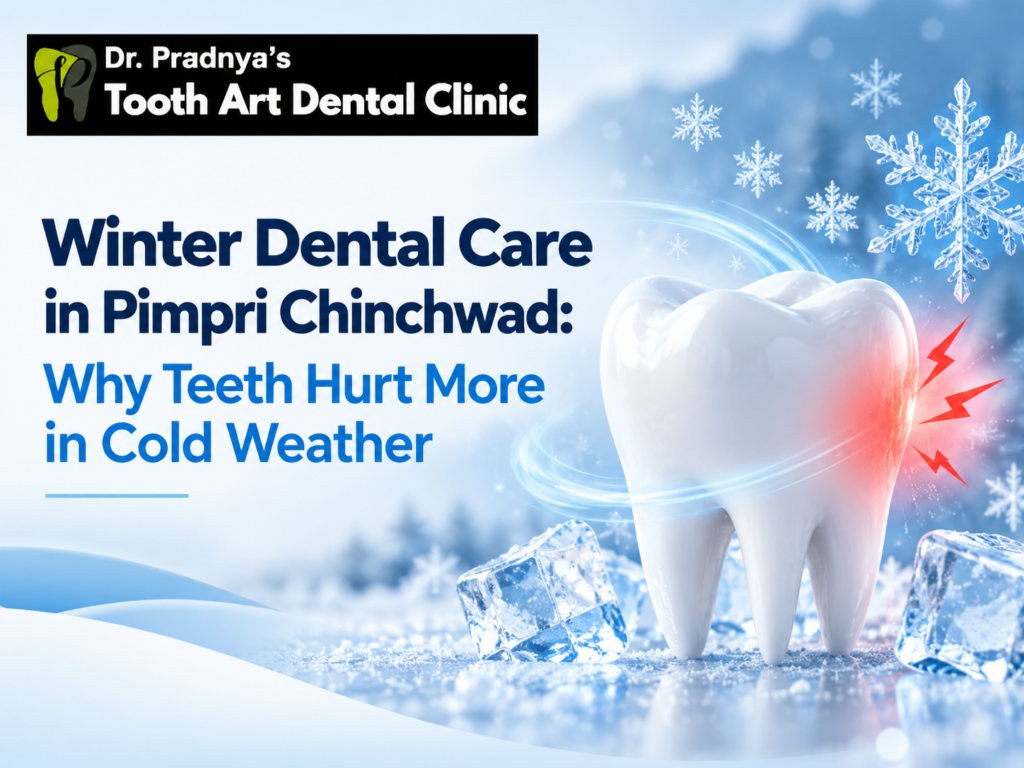
Winter teeth sensitivity in Pimpri Chinchwad affects many patients from December through February when Pune-region temperatures drop to 10 to 15 degrees Celsius overnight and morning cold air is sharp enough to trigger dental discomfort. For patients with pre-existing tooth sensitivity from exposed dentine, the cold months are the most uncomfortable dental period of the year.
Dr. Pradnya Mahajan, BDS, at Tooth Art Dental Clinic in Akurdi, receives a notable increase in sensitivity-related appointments and calls in November and December, directly following the post-festive season sugar exposure combined with the onset of cold weather. This guide explains why cold triggers tooth pain, which teeth are most at risk and what you can do at home and in the clinic.
Quick Facts
- Normal Winter Temperature Range (Pimpri Chinchwad): 10 to 22 degrees Celsius (Dec to Feb)
- Why Cold Causes Sensitivity: Thermal contraction triggers fluid movement in dentine tubules, stimulating the nerve
- Most Sensitive Teeth: Those with enamel erosion, gum recession, recent scaling or old cracks
- Best Home Treatment: Sensitivity toothpaste (potassium nitrate or stannous fluoride) twice daily
- Clinical Treatment: Fluoride varnish, dentine bonding agent, or desensitising treatment at Tooth Art Dental
- When to Seek Urgent Care: Cold sensitivity localised to one tooth only; may indicate fracture or failing restoration
Winter Dental Sensitivity Statistics, Pimpri Chinchwad 2025-2026
| Metric | Data Point | Source |
| Adults with dentine hypersensitivity in India | Approx. 25 to 40% of adults | ICMR and Industry estimate |
| Temperature sensitivity trigger for most sensitive teeth | Below 15 degrees Celsius (air or beverage) | Industry estimate |
| Potassium nitrate toothpaste effectiveness for sensitivity | 60 to 80% reduction in sensitivity after 4 to 8 weeks | PubMed: Journal of Clinical Dentistry 2021 |
| Fluoride varnish effect on dentine sensitivity | Significant reduction within 24 to 48 hours | PubMed: Dental Research Journal 2022 |
| Sensitivity toothpaste cost in India | INR 80 to 200 per tube (Sensodyne, Colgate Sensitive Pro) | Industry estimate |
| Fluoride varnish application cost at Akurdi clinics | INR 300 to 800 per session | Industry estimate |
| Patients with cold sensitivity who have an underlying untreated cavity | Approx. 20 to 30% | Industry estimate |
Why Does Cold Weather Cause Tooth Pain?
Teeth have dentine, a porous layer beneath the enamel, containing thousands of microscopic tubules that run from the tooth surface to the dental pulp (nerve). When enamel or gum tissue covers the dentine, these tubules are sealed and the nerve is protected from external stimuli.
When the dentine is exposed (due to enamel erosion, gum recession, abrasion from hard brushing or cracks in the enamel), cold air or liquids rapidly change the temperature of the fluid inside the dentine tubules. This sudden fluid movement is detected by the nerve at the pulp, triggering sharp, short-lived pain. In winter, this mechanism is activated every time cold air enters the mouth; even breathing through the mouth in cold morning air in Pimpri Chinchwad can trigger sensitivity.
Common Causes of Winter Tooth Sensitivity in Pimpri Chinchwad
Causes of Winter Tooth Sensitivity and Recommended Action
| Cause | What It Means and What to Do |
| Enamel erosion from acidic diet (citrus, cola, tamarind) | Dentine exposed; use sensitivity toothpaste; avoid acidic food after brushing |
| Gum recession exposing root surface | Root dentine has no enamel; very sensitive; see Dr. Pradnya for assessment |
| Recent scaling (within 2 to 4 weeks) | Normal post-scaling sensitivity; resolves; use sensitivity toothpaste temporarily |
| Bruxism (night grinding) wearing down enamel | Enamel thinned; need night guard; sensitivity toothpaste for symptom management |
| Overzealous brushing with hard brush | Gum recession and enamel abrasion; switch to soft toothbrush and correct technique |
| Cracked tooth (incomplete fracture) | Localised cold sensitivity on one specific tooth; requires evaluation; may need crown |
| Old filling with a gap at the margins | Cold getting into the cavity under the filling; filling replacement needed |
| Post-whitening sensitivity (from October Diwali whitening) | Temporary open dentine pores; resolves within 2 to 4 weeks; sensitivity toothpaste helps |
The Best Home Treatments for Winter Sensitivity
Sensitivity Toothpaste
Toothpastes containing potassium nitrate (such as Sensodyne, Colgate Sensitive Pro-Relief or equivalent) or stannous fluoride are the first-line home treatment for generalised cold sensitivity. Potassium nitrate penetrates dentine and desensitises the nerve endings in the dentine tubules. The key is consistent twice-daily use for a minimum of 4 to 6 weeks. Using sensitivity toothpaste occasionally produces no meaningful benefit; it must be used as your regular toothpaste.
Leave Toothpaste on Sensitive Areas
After brushing, spit out the foam but do not rinse with water. The residual sensitivity toothpaste left on the tooth surface continues to act for several hours. This simple habit approximately doubles the effectiveness of the active ingredient compared to rinsing immediately after brushing.
Avoid Acidic Food Immediately After Brushing
Brushing opens the dentine tubules slightly. Eating or drinking acidic food within 30 minutes of brushing (lime juice, tamarind, citrus) adds acid directly to the temporarily exposed dentine. Wait 30 minutes after eating acidic food before brushing.
Winter Dental Care Plan: At Home and at Tooth Art Dental, Akurdi
| Situation | Home Action | Clinic Action at Tooth Art Dental |
| Generalised cold sensitivity | Sensitivity toothpaste twice daily for 6 weeks | Fluoride varnish application; check for enamel erosion |
| Sensitivity on one specific tooth only | Sensitivity toothpaste while waiting for appointment | X-ray and clinical assessment; check for crack or failing restoration |
| Post-scaling sensitivity (within 4 weeks) | Sensitivity toothpaste; avoid very cold drinks | Normal; reassure; review at 4 weeks |
| Gum recession with root sensitivity | Sensitivity toothpaste; soft toothbrush; correct brushing angle | Dentine bonding agent or gum grafting assessment |
| Sensitivity from enamel erosion | Reduce acidic food frequency; do not brush immediately after acid | Fluoride varnish; dietary counselling; monitor erosion severity |
| Dry mouth from cold-weather mouth breathing | Drink water frequently; use humidifier at night | Fluoride varnish; cavity risk assessment; saliva stimulation advice |
Fluoride Varnish Application for Sensitive Teeth at Tooth Art Dental, Akurdi
| Step | What Happens | Duration | Benefit |
| 1 | Teeth dried with air; no drilling; no anaesthesia needed | 2 min | Prepares surface for maximum varnish uptake |
| 2 | Fluoride varnish painted onto sensitive tooth surfaces with a soft brush | 5 to 10 min | Seals dentine tubules; reduces sensitivity within 24 to 48 hr |
| 3 | Varnish sets in seconds; patient instructed not to eat hard food for 2 hours | Immediate | Varnish hardening on tooth surface |
| 4 | Avoid eating for 30 min; avoid brushing for 4 to 6 hours after application | Patient instruction | Allows maximum fluoride uptake into enamel |
Winter Dental Care in Akurdi and Pimpri Chinchwad
The winter months (December to February) in Pimpri Chinchwad are also a period of lower daily water intake for many patients, increasing the risk of dry mouth and reduced saliva production. Saliva is the mouth’s natural protective fluid: it neutralises acid, remineralises enamel and washes away food particles. During winter, patients who drink less water or breathe through the mouth in cold air reduce their salivary protection.
Dr. Pradnya at Tooth Art Dental in Akurdi recommends that patients who notice increased sensitivity in winter book a fluoride varnish application appointment in November or December. A single varnish application provides 3 to 6 months of increased enamel protection and is available at no significant extra cost alongside the routine check-up.
Frequently Asked Questions
Q: My teeth are fine in summer but hurt every winter. What is causing this?
A: This seasonal pattern strongly suggests dentine hypersensitivity. The cold air of Pimpri Chinchwad’s winter months (10 to 15 degrees Celsius) triggers fluid movement in exposed dentine tubules. Your enamel is sufficient during warmer months when temperature changes are less extreme, but the cold winter air pushes your sensitivity threshold. Consistent use of sensitivity toothpaste through October and November (before the cold sets in) can prevent this pattern.
Q: Does sensitivity toothpaste work for winter tooth pain?
A: Yes, for generalised cold sensitivity caused by exposed dentine. Potassium nitrate toothpastes like Sensodyne or Colgate Sensitive Pro-Relief reduce sensitivity by 60 to 80 percent after 4 to 8 weeks of consistent twice-daily use. For best results, use it as your only toothpaste (not alternating with regular toothpaste) and leave residual paste on the teeth after brushing rather than rinsing. If sensitivity does not improve after 6 weeks, book an assessment at Tooth Art Dental in Akurdi.
Q: Can I still drink cold water or eat ice cream in winter if my teeth are sensitive?
A: You do not need to avoid cold foods permanently. While your sensitivity is active, it helps to sip cold water rather than gulping it (reducing the sudden temperature shock to the teeth) and to let ice cream sit in the mouth briefly before chewing. Longer-term, the goal is to treat the underlying cause through sensitivity toothpaste or a professional fluoride varnish application so that cold foods are no longer a concern.
Q: One specific tooth hurts with cold air but the others are fine. Is this different?
A: Yes, this is a clinically important distinction. Sensitivity in one specific tooth, particularly a cold pain that lingers for more than 30 seconds after the trigger is removed, suggests the nerve (pulp) of that tooth is inflamed (irreversible pulpitis) or the tooth has a crack. This is different from generalised cold sensitivity and requires a clinical examination and X-ray at Tooth Art Dental in Akurdi. Sensitivity toothpaste will not resolve a pulpal problem.
Q: Is there anything the dentist can do for winter sensitivity beyond sensitivity toothpaste?
A: Yes. In-office treatments for dentine hypersensitivity at Tooth Art Dental in Akurdi include: fluoride varnish application (seals dentine tubules; lasts 3 to 6 months; INR 300 to 800), dentine bonding agent application (resin seals exposed root surfaces; longer lasting), and composite build-up to cover exposed root dentine in severe recession cases. For patients with bruxism-related enamel wear causing sensitivity, a custom night guard (INR 3,000 to 6,000) prevents further enamel loss and reduces sensitivity over time.
Conclusion
Winter teeth sensitivity in Pimpri Chinchwad is common, manageable and largely preventable. Consistent use of potassium nitrate sensitivity toothpaste from October onwards, a fluoride varnish application at your pre-winter check-up and avoiding acidic foods immediately after brushing are the three steps that protect most sensitive teeth through the cold months.
Book your winter sensitivity check-up with Dr. Pradnya Mahajan at Tooth Art Dental Clinic in Akurdi at https://drpradnyastoothartdental.in/contact
Dr.Pradnya's Dental Clinic
At Dr. Pradnya’s Tooth Art Dental Clinic, we believe a healthy smile builds confidence and improves overall well-being. Founded by Dr. Pradnya Mahajan, our clinic in Nigdi is dedicated to providing gentle, advanced, and personalized dental care for patients of all ages.
We offer a wide range of treatments including pediatric dentistry, braces & aligners, dental implants, root canal therapy, cosmetic dentistry, and preventive care.