Table of contents
Key Takeaways
- A well-maintained zirconia or PFM dental bridge in Pimpri Chinchwad lasts 10 to 15 years on average; some bridges last 20 years or more with excellent home care.
- The most common reasons bridges fail prematurely are secondary decay under the crown margins and calculus buildup under the pontic causing gum disease on the abutment teeth.
- Flossing under the bridge with a floss threader or water flosser is the single most important maintenance habit for bridge longevity.
- Regular 6-monthly check-ups and X-rays at Tooth Art Dental in Akurdi monitor the abutment teeth under the bridge for early decay that is invisible to the naked eye.
- A dental bridge does not prevent bone loss at the missing tooth site; an implant is the only tooth replacement option that stimulates and preserves jaw bone.
- When a bridge fails after 10 to 15 years, the abutment teeth often require fresh root canal treatment or have insufficient structure to support a new bridge; an implant may become the better option at this stage.
Dental bridge lifespan and maintenance in Pimpri Chinchwad is one of the most important subjects for the many patients at Tooth Art Dental in Akurdi who have had a dental bridge placed to replace a missing tooth. A bridge is a significant investment of INR 12,000 to 25,000 for a 3-unit bridge, and understanding how to make it last as long as possible directly affects the value you get from that investment. Dr. Pradnya Mahajan, BDS, at Tooth Art Dental Clinic in Akurdi, sees both excellent outcomes from well-maintained bridges and premature failures from neglected ones. The difference almost always comes down to maintenance habits and 6-monthly check-ups
Quick Facts
- Average Bridge Lifespan: 10 to 15 years (well-maintained); up to 20+ years with excellent care
- Zirconia Bridge Cost (3-unit) in Pimpri Chinchwad: INR 12,000 to 30,000
- Most Common Failure Cause: Secondary decay under crown margins of abutment teeth
- Second Most Common Failure: Gum disease on abutment teeth from calculus under pontic
- Key Maintenance Tool: Floss threader or water flosser to clean under the pontic
- Does a Bridge Prevent Bone Loss? No; bone loss continues under the pontic
Dental Bridge Lifespan and Maintenance Statistics, Pimpri Chinchwad 2025-2026
| Metric | Data Point | Source |
| Average dental bridge lifespan with good maintenance | 10 to 15 years | PubMed: Journal of Prosthetic Dentistry 2022 |
| Bridge failure rate at 10 years (all causes) | Approx. 20 to 30% | PubMed: European Journal of Dentistry 2022 |
| Most common cause of bridge failure | Secondary caries (decay under crown margin): 35 to 45% of failures | Industry estimate |
| 3-unit zirconia bridge cost, Pimpri Chinchwad | INR 12,000 to 30,000 | Industry estimate |
| 3-unit PFM bridge cost, Pimpri Chinchwad | INR 8,000 to 18,000 | Industry estimate |
| Patients who floss under their bridge regularly | Approx. 25 to 35% (very low) | Industry estimate |
| Bone loss at missing tooth site per year without implant | 1 to 2 mm per year on average | WHO Oral Health Advisory |
What Is a Dental Bridge?
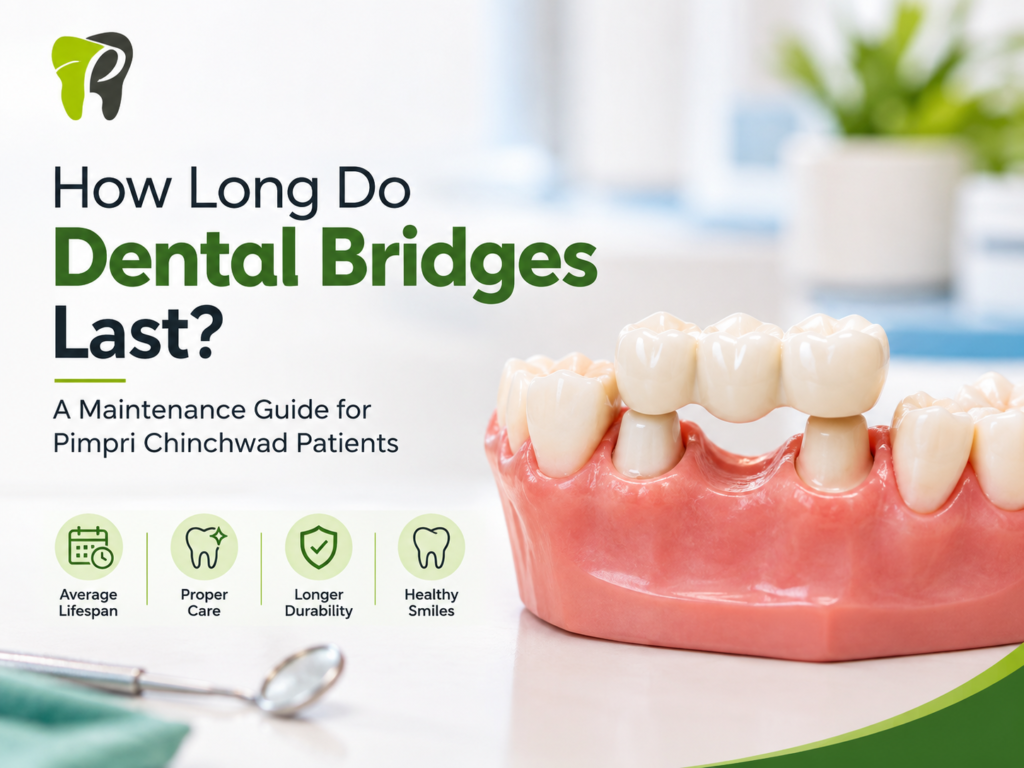
A dental bridge replaces a missing tooth by anchoring an artificial tooth (pontic) between two crowns placed on the neighbouring teeth (abutment teeth). The three units fused together form a bridge across the gap. Traditional bridges require the abutment teeth to be reduced (shaped) to receive the crowns, which is an irreversible preparation.
Bridges can be made from different materials: PFM (porcelain fused to metal), full zirconia or metal. Zirconia bridges are the modern first choice at Tooth Art Dental in Akurdi because they are metal-free, biocompatible with gum tissue, highly aesthetic and very strong.
What Makes a Bridge Last Longer?
Home Care: Cleaning Under the Pontic
The underside of the pontic (the artificial tooth in the middle) sits against the gum tissue but cannot be brushed in the normal way. Plaque and food particles accumulate in this area, leading to calculus buildup, gum inflammation around the abutment teeth and eventually bone loss. Flossing under the bridge using a floss threader (a small plastic needle to thread floss under the pontic) is the essential daily habit for bridge maintenance. A water flosser is even more effective and more convenient for patients who find the floss threader technique difficult.
Regular X-Ray Monitoring
Secondary decay under the crown margins of the abutment teeth is invisible from outside the crown. It grows silently for months or years until the tooth is significantly damaged. A periapical X-ray taken at every 6-monthly check-up at Tooth Art Dental in Akurdi reveals decay under the crown margins at an early, treatable stage. Patients who skip check-ups are the ones who present with a bridge that has failed because the abutment tooth has decayed to the point of needing extraction.
Professional Scaling at Every Check-Up
The pontic area accumulates calculus that cannot be removed by brushing or home flossing. Professional scaling at 6-monthly check-up appointments removes calculus from the underside of the pontic, the crown margins and the gum sulcus around the abutment teeth, preventing the gum disease that is the second most common cause of bridge failure.
Factors That Shorten or Extend Bridge Lifespan
| Factors That Shorten Bridge Lifespan | Factors That Extend Bridge Lifespan |
| Not flossing under the pontic daily | Daily flossing with floss threader or water flosser |
| Missing 6-monthly check-ups and X-rays | 6-monthly check-ups and periapical X-rays |
| Night grinding without a night guard | Wearing a night guard if bruxism is present |
| Biting hard objects directly on the bridge | Avoiding hard, crunchy foods on the bridge side |
| Heavy tea and coffee without rinsing | Rinsing with water after staining foods and drinks |
| Pre-existing gum disease on abutment teeth not treated | Professional scaling before and regularly after bridge placement |
| Poor crown marginal fit from low-quality lab | High-quality CAD/CAM fabricated zirconia bridge with precise margins |
Dental Bridge Maintenance Schedule at Tooth Art Dental, Akurdi
| Timeframe | Action | Who Does It | Why |
| Daily | Floss under the pontic with floss threader or water flosser | Patient at home | Prevents plaque and calculus accumulation under pontic |
| Daily | Brush twice with soft toothbrush along crown margins | Patient at home | Prevents secondary decay at crown-tooth junction |
| Every 6 months | Professional scaling including pontic area | Dr. Pradnya | Removes calculus that home care cannot reach |
| Every 6 months | Periapical X-ray of abutment teeth | Dr. Pradnya | Detects secondary decay before it causes bridge failure |
| Every 12 months | Check bridge cement integrity; check bite | Dr. Pradnya | Identifies cement washout or bite changes early |
| As needed | Polishing of pontic surface | Dr. Pradnya | Maintains stain resistance and smooth surface |
Bridge vs Implant: The Long-Term Consideration
A dental bridge does not prevent bone loss at the missing tooth site. The jaw bone that once supported the extracted tooth’s root resorbs over time because it receives no stimulation. At 1 to 2 mm of bone loss per year, a patient who had a bridge placed at age 40 may have significant bone loss at the pontic site by age 55. This matters because if the bridge eventually fails and the patient wants an implant, there may not be enough bone remaining without a bone graft.
A dental implant prevents this bone loss entirely by simulating the stimulation of a tooth root. For younger patients in Pimpri Chinchwad considering tooth replacement, Dr. Pradnya discusses both the bridge and implant options with honest long-term projections. A bridge is a faster and less invasive immediate solution; an implant is the superior long-term investment if bone preservation matters.
Frequently Asked Questions
Q: My dental bridge is 8 years old. How do I know if it needs to be replaced?
A: Signs that a bridge may need replacement include: sensitivity to cold or sweet under the bridge (indicating secondary decay on the abutment tooth), visible darkening of the gum at the bridge margin (often a metal margin becoming exposed), bridge that feels loose or sounds hollow when tapped, or persistent bad breath that does not resolve with cleaning. An X-ray at Tooth Art Dental in Akurdi will reveal the abutment tooth status definitively.
Q: How do I clean under my dental bridge?
A: Use a floss threader (available at pharmacies) to thread dental floss through the space between the pontic and the gum. Slide the floss back and forth under the pontic and along the abutment teeth on both sides. A water flosser (oral irrigator) is even more effective, directing a pressurised stream of water under the bridge. Do this once daily, ideally before your evening brushing. If you need help with the technique, ask Dr. Pradnya at your next check-up at Tooth Art Dental.
Q: What happens if a bridge abutment tooth needs a root canal after the bridge is placed?
A: If one of the abutment teeth supporting the bridge develops pulpitis requiring root canal treatment, it is often possible to perform the root canal through a small access hole drilled through the crown of the bridge. After the root canal is completed, the access hole is filled with composite. This avoids having to remove and replace the entire bridge if the bridge is otherwise in good condition and the abutment tooth structure is sound.
Q: How much does it cost to replace a dental bridge in Pimpri Chinchwad?
A: Replacing an old bridge with a new 3-unit zirconia bridge at Tooth Art Dental in Akurdi costs INR 12,000 to 30,000. If the abutment teeth have decay that needs treating or root canal treatment before the new bridge can be placed, additional costs apply. If the abutment teeth have insufficient structure to support another bridge, implants may be the appropriate alternative.
Q: Can I eat normally with a dental bridge?
A: Yes, within reason. A well-fitted zirconia bridge can withstand normal eating including most firm foods. Avoid biting directly into very hard foods (whole sugarcane, hard bones, ice) on the bridge side and very sticky foods that could dislodge the bridge cement. The main dietary caution after bridge placement is the initial 2 to 4 weeks when the cement is curing to its maximum strength; eat on the opposite side during this period.
Conclusion
Dental bridge lifespan in Pimpri Chinchwad reaches 10 to 15 years with consistent home care and 6-monthly professional maintenance. The critical habits are daily flossing under the pontic and regular periapical X-rays to catch secondary decay before it causes bridge failure. Investing in maintenance is always less expensive than replacing a failed bridge.
Book your bridge check-up or a consultation for a new bridge with Dr. Pradnya Mahajan at Tooth Art Dental Clinic in Akurdi at https://drpradnyastoothartdental.in/contact

Dr.Pradnya's Dental Clinic
At Dr. Pradnya’s Tooth Art Dental Clinic, we believe a healthy smile builds confidence and improves overall well-being. Founded by Dr. Pradnya Mahajan, our clinic in Nigdi is dedicated to providing gentle, advanced, and personalized dental care for patients of all ages.
We offer a wide range of treatments including pediatric dentistry, braces & aligners, dental implants, root canal therapy, cosmetic dentistry, and preventive care.