Key Takeaways
- Zirconia crowns are milled from solid blocks of zirconium oxide using CAD/CAM (computer-aided design and manufacturing) technology, giving them exceptional strength and precision.
- The full zirconia crown procedure at Tooth Art Dental in Akurdi takes 2 to 3 visits over 1 to 2 weeks: preparation, temporary crown, then final fitting.
- Zirconia is the strongest all-ceramic crown material available today, with flexural strength of 900 to 1,200 MPa compared to 80 to 120 MPa for conventional feldspathic porcelain.
- Zirconia crowns are biocompatible, metal-free and gum-friendly: they cause less gum tissue irritation than metal-based crowns.
- Zirconia crown cost in Pimpri Chinchwad ranges from INR 6,000 to 12,000, making it the recommended choice for both front and back teeth.
- Post-crown care involves brushing twice daily, flossing at the crown margins and avoiding biting directly into extremely hard foods.
Zirconia crowns in Pimpri Chinchwad have become the gold standard for dental crown restorations at Tooth Art Dental in Akurdi, replacing both metal (gold and cobalt-chromium) and older porcelain-fused-to-metal (PFM) crowns as the preferred option for most patients. Understanding how zirconia crowns are made and what the procedure involves helps patients at Tooth Art Dental make confident, informed decisions about their treatment.
Quick Facts
- Material: Zirconium oxide (ZrO2); a ceramic not a metal
- Manufacturing Method: CAD/CAM milling from sintered zirconia blocks
- Flexural Strength: 900 to 1,200 MPa (exceptional for an all-ceramic material)
- Zirconia Crown Cost in Pimpri Chinchwad: INR 6,000 to 12,000
- Lifespan: 15 to 20 years with proper care
- Number of Visits: 2 to 3 visits over 1 to 2 weeks
Zirconia Crown Statistics, Pimpri Chinchwad 2025-2026
| Metric | Data Point | Source |
| Zirconia crown cost per tooth, Pimpri Chinchwad | INR 6,000 to 12,000 | Industry estimate |
| Zirconia flexural strength vs porcelain | 900 to 1,200 MPa vs 80 to 120 MPa | PubMed: Journal of Prosthetic Dentistry 2022 |
| 10-year zirconia crown survival rate | 95 to 97% | PubMed: International Journal of Prosthodontics 2022 |
| Zirconia vs PFM: gum tissue response | Zirconia causes significantly less gingival inflammation | PubMed: Journal of Periodontology 2021 |
| Market share of zirconia crowns in urban India | Approx. 60 to 70% of all crown prescriptions 2025 | Industry estimate |
| CAD/CAM turnaround time for zirconia crown at partner lab | 3 to 5 business days | Industry estimate |
| Porcelain chipping rate: PFM vs full zirconia at 5 years | PFM: 15 to 25% chipping; zirconia: less than 3% | PubMed: European Journal of Dentistry 2022 |
What Is a Zirconia Crown?
A dental crown is a tooth-shaped cap that fits over a prepared natural tooth to restore its shape, size, strength and appearance. Zirconia is the specific material: zirconium oxide, a ceramic compound with extraordinary mechanical strength. Unlike traditional porcelain, which is brittle, or metal, which is opaque, zirconia combines strength with a tooth-like appearance, making it suitable for both front and back teeth.
Zirconia crowns come in two types: monolithic zirconia (solid zirconia throughout) for maximum strength, typically used for back teeth; and layered zirconia (zirconia substructure with a thin porcelain overlay) for maximum aesthetics, typically used for highly visible front teeth. Dr. Pradnya at Tooth Art Dental in Akurdi recommends monolithic zirconia for posterior crowns due to its chip-resistance and layered zirconia for cases where the highest aesthetic result is needed on front teeth.
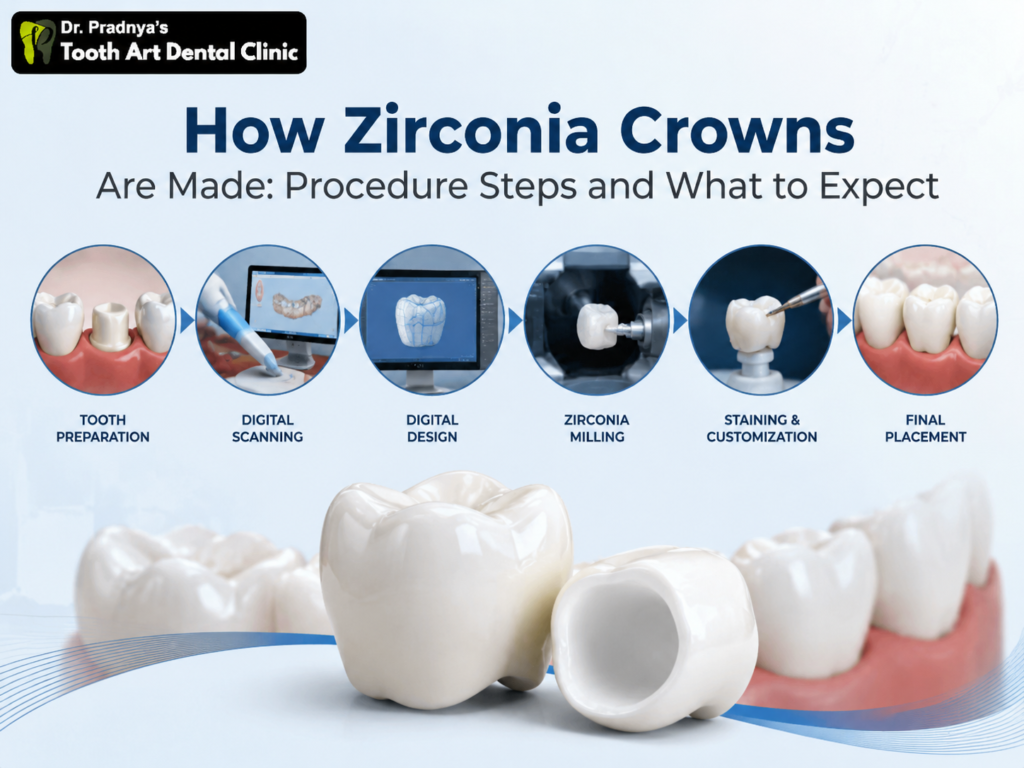
How Zirconia Crowns Are Made: The CAD/CAM Process
Step 1: Digital Design (CAD)
After the tooth is prepared and an impression is taken, the impression is scanned by the dental laboratory using a precision 3D scanner. The scanned data is imported into dental CAD software (such as 3Shape or Exocad). The dental technician designs the crown digitally, defining the exact shape, contacts with adjacent teeth and occlusal (biting) surface in precise detail. The digital design takes 30 to 90 minutes.
Step 2: Milling (CAM)
The digital design is sent to a CNC milling machine. A pre-sintered zirconia block is loaded into the machine. Five-axis milling arms cut the crown shape from the block with diamond-coated burs in 10 to 30 minutes. The milled crown at this stage is oversized by approximately 20 to 25 percent to account for the next step.
Step 3: Sintering
The milled zirconia crown is placed in a sintering furnace at approximately 1,400 to 1,600 degrees Celsius. Over 6 to 8 hours, the zirconia densifies and shrinks by precisely 20 to 25 percent to its final dimensions, becoming fully hardened and achieving its maximum density and strength. This sintering step is what gives zirconia its exceptional hardness. No other ceramic achieves this combination of properties.
Step 4: Colouring, Glazing and Polishing
The sintered crown is shade-matched by staining the surface with ceramic colourants to replicate the natural gradations of tooth colour. A glaze is fired over the crown to create the lustrous, smooth surface that resists staining. For layered zirconia crowns, a thin layer of feldspathic porcelain is hand-applied and fired over the facial surface for maximum translucency.
Zirconia Crown Procedure: Step-by-Step at Tooth Art Dental, Akurdi
| Step | What Happens | Chair Time | Visit |
| 1: Consultation and X-ray | Clinical and X-ray assessment; treatment plan and cost confirmed | 20 to 30 min | Visit 1 |
| 2: Tooth preparation | 1 to 1.5 mm reduction around tooth circumference under local anaesthesia; shade taken | 30 to 45 min | Visit 1 |
| 3: Impression | Digital scan or physical impression of prepared tooth and adjacent teeth | 15 to 20 min | Visit 1 |
| 4: Temporary crown | Acrylic temporary crown fitted and cemented to protect prepared tooth | 10 to 15 min | Visit 1 |
| 5: Crown fabrication | CAD/CAM zirconia crown fabricated at partner lab in Pune | 3 to 5 days | Lab |
| 6: Try-in and cementation | Crown tried in, contacts and bite checked, adjustments made, permanently cemented with glass ionomer or resin | 30 to 45 min | Visit 2 |
Zirconia Crown vs Other Crown Types
Crown Material Comparison for Pimpri Chinchwad Patients
| Factor | Zirconia | PFM (Porcelain-Fused-to-Metal) | Full Metal (Gold/Cobalt) |
| Material | ZrO2; ceramic; no metal | Metal base; porcelain surface | Gold or cobalt-chromium alloy |
| Strength | 900 to 1,200 MPa; excellent | Porcelain: 80 to 120 MPa (chips) | Very strong; resistant to fracture |
| Aesthetics | Excellent; tooth-coloured throughout | Good; but metal margin shows at gum | Poor; visible metallic colour |
| Biocompatibility | Excellent; no metal ions | Moderate; metal ions possible | Good for gold; cobalt less so |
| Gum response | Minimal inflammation | Metal margin can irritate gums | Acceptable for gold |
| Cost (Pimpri) | INR 6,000 to 12,000 | INR 4,000 to 8,000 | INR 3,000 to 7,000 |
| Lifespan | 15 to 20 years | 10 to 15 years (porcelain chips) | 15 to 20 years |
| Dr. Pradnya’s recommendation | First choice for all cases | Acceptable for posterior if budget limited | Only for hidden molars if indicated |
Post-Treatment Oral Hygiene for Zirconia Crowns: Brush twice daily with a soft toothbrush and non-abrasive fluoride toothpaste. Floss once daily at the crown margins to prevent secondary decay forming at the gum line between the crown edge and the natural tooth. Avoid biting directly into very hard foods like ice, hard nuts and hard bones. If you grind your teeth at night, tell Dr. Pradnya so a night guard can be made to protect the crown. A night guard significantly extends crown lifespan.
Zirconia Crowns in Akurdi and Pimpri Chinchwad
Tooth Art Dental in Akurdi works with a partner CAD/CAM dental laboratory in Pune with a 3 to 5 business day zirconia crown turnaround. This means most patients complete their crown process in 2 clinic visits over 1 to 2 weeks. Dr. Pradnya personally reviews every crown at the try-in stage for shade accuracy, marginal fit and occlusal contacts before cementation.
Frequently Asked Questions
Q: How long does a zirconia crown last in Pimpri Chinchwad?
A: Zirconia crowns have a documented 10-year survival rate of 95 to 97 percent and typically last 15 to 20 years with proper care. The most common causes of failure are cement washout at the crown margin (which allows secondary decay to form under the crown) and fracture from heavy biting forces without a night guard in patients who grind teeth. Regular 6-monthly check-ups at Tooth Art Dental confirm the crown margin integrity.
Q: Does getting a zirconia crown hurt?
A: The tooth preparation is performed under local anaesthesia, so there is no pain during the procedure. After the temporary crown is placed, some cold sensitivity is normal for 1 to 2 weeks until the permanent zirconia crown is cemented. After permanent cementation, sensitivity resolves in most patients. If sensitivity persists for more than 2 weeks after the final crown is placed, contact Tooth Art Dental for a review appointment.
Q: What is the difference between a zirconia crown and a ceramic crown?
A: All zirconia crowns are ceramic, but not all ceramic crowns are zirconia. Traditional dental ceramics include feldspathic porcelain and glass ceramics (e-max), which are highly aesthetic but less strong. Zirconia (zirconium oxide) is an exceptionally hard and tough ceramic specifically chosen for dental crowns because it combines strength comparable to metal with the aesthetics of a tooth-coloured material. It is the strongest all-ceramic option available for dental crowns in Pimpri Chinchwad.
Q: How much does a zirconia crown cost in Akurdi in 2026?
A: A zirconia crown at Tooth Art Dental in Akurdi costs INR 6,000 to 12,000 in 2026, including laboratory fabrication, cementation and follow-up bite check. The final cost depends on the tooth type (front vs back), whether layered or monolithic zirconia is used and whether a post-and-core build-up is required before the crown can be placed. All costs are confirmed in writing before treatment begins.
Q: My PFM crown has a black line at the gum. Can it be replaced with zirconia?
A: Yes. The black or dark line visible at the gum of an older PFM crown is the metal substructure showing through as the gum tissue has receded or the metal margin has become exposed. This can be addressed by replacing the PFM crown with a full zirconia crown that has no metal margin. Dr. Pradnya at Tooth Art Dental in Akurdi can assess whether the underlying tooth structure and root canal status support a crown replacement.
Conclusion
Zirconia crown procedure steps in Akurdi involve a precision CAD/CAM manufacturing process that produces a crown stronger than any other ceramic material available, with exceptional aesthetics and long-term biocompatibility. The 2 to 3 visit process at Tooth Art Dental takes 1 to 2 weeks from preparation to final cementation.
Book your zirconia crown consultation with Dr. Pradnya Mahajan at Tooth Art Dental Clinic in Akurdi at https://drpradnyastoothartdental.in/contact
Medical Disclaimer:
This article is for informational purposes only and does not constitute professional medical advice, diagnosis or treatment. Always consult a qualified dental professional before making decisions about your oral health. Readers in Pimpri Chinchwad and surrounding areas are encouraged to book a consultation with a registered dentist.

Dr.Pradnya's Dental Clinic
At Dr. Pradnya’s Tooth Art Dental Clinic, we believe a healthy smile builds confidence and improves overall well-being. Founded by Dr. Pradnya Mahajan, our clinic in Nigdi is dedicated to providing gentle, advanced, and personalized dental care for patients of all ages.
We offer a wide range of treatments including pediatric dentistry, braces & aligners, dental implants, root canal therapy, cosmetic dentistry, and preventive care.